Street Photography
A camera, an eye, and a keen sense of curiosity—sometimes that’s all it takes to transform a simple moment into something worth capturing.
Technically, any image taken outside the studio qualifies as street photography. But for me, it’s always been something more—an art form I connected with at an early age.
Growing up in New Jersey, I was drawn to the work of legends like Berenice Abbott, Walker Evans, and Lee Friedlander. Their photographs sparked a deep fascination with the visual language of the street.
As a high school student in Livingston, NJ, I would often ask my parents to drive me to the library one town over, where the research facilities were better. I timed those visits to match the NJ Transit schedule so I could catch the train to the PATH station and explore New York City—a city my own town lacked direct access to, unlike nearby Millburn.
Thanks to a liberal arts high school education (shoutout to Mr. Pop, my photography teacher) and the raw, gritty canvas that was 1980s New York—before Mayor Giuliani’s gentrification—I immersed myself in street photography.
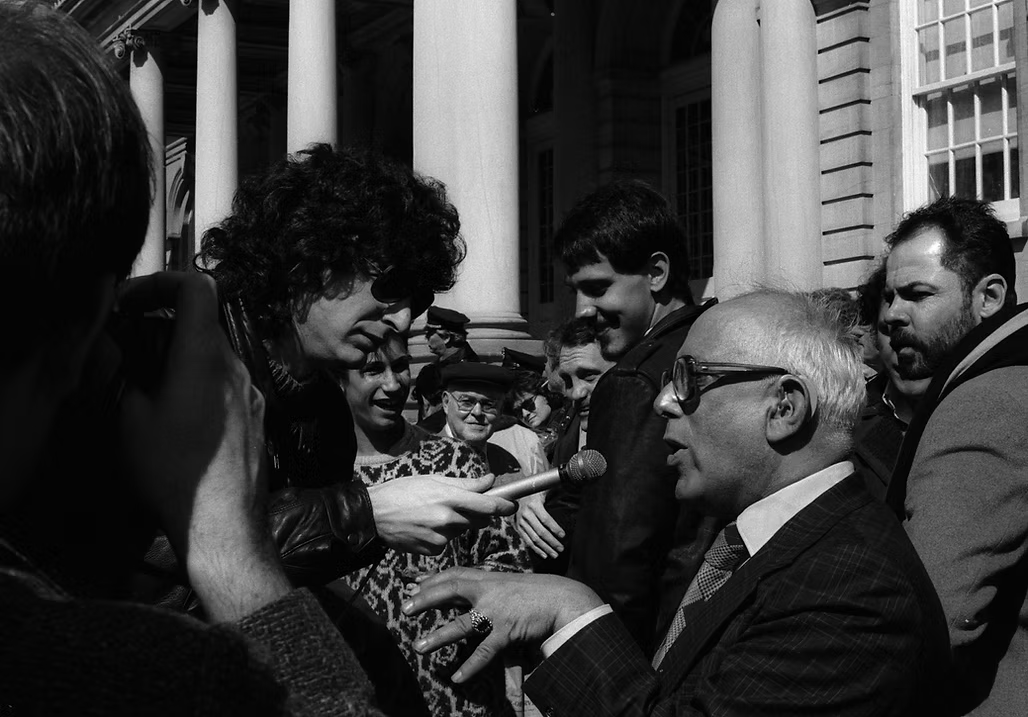
Now, almost 40 years later, I’m still learning. I’ve studied the work of later masters like Garry Winogrand, Joel Meyerowitz, and Henri Cartier-Bresson and the countless others who followed.
It all began with Eugène Atget (1857–1927), the father of street photography, who was determined to document “Old Paris” before modernization erased it.
In his era, the private world of the home was vanishing, and life was increasingly unfolding in public. The street became the stage- the theater—and the camera, the means to record its performance.
Atget photographed laborers, architecture (inside and out), parks, gardens, and storefronts using the tools of his time. His attention to detail and his drive to preserve the disappearing city laid the foundation for how many of us approach street photography today.

 viewfromthehandlebars.com