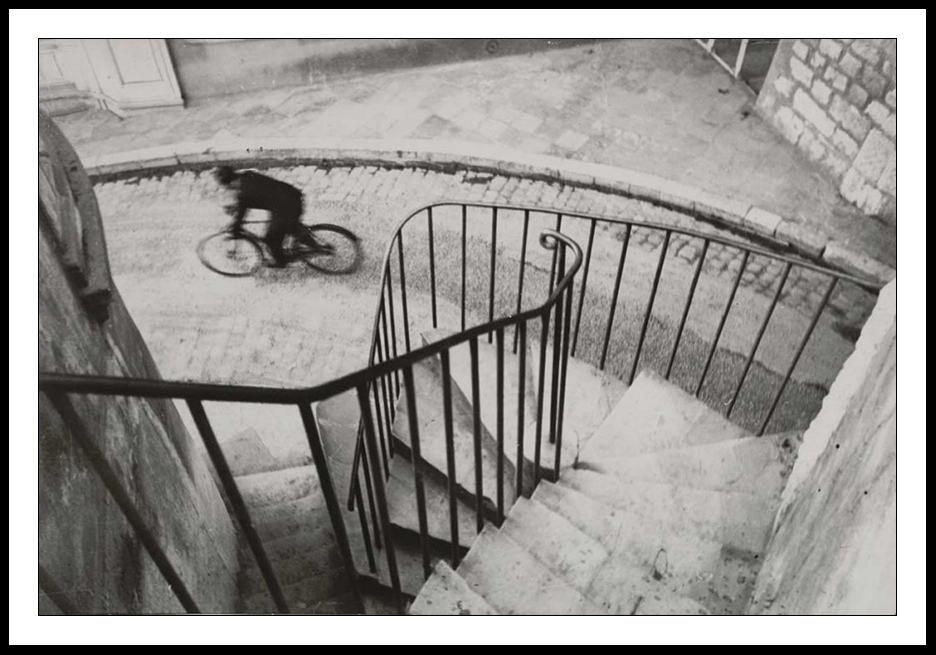
Henri Cartier-Bresson (1908–2004) is regarded as the father of modern photojournalism and one of the most influential figures in 20th-century photography.
The Decisive Moment
Cartier-Bresson popularized the idea that photography is about anticipating and capturing the instant when form, content, and emotion align perfectly. In his 1952 book Images à la Sauvette (The Decisive Moment in English), he argued that photography is not about staging but about recognizing and seizing fleeting events that reveal deeper truths about life.
Style and Approach
- Street Photography Pioneer: He roamed cities with his Leica 35mm camera, blending into the environment and capturing candid, unposed scenes.
- Compositional Mastery: He had a painter’s eye (trained in painting before turning to photography), relying heavily on geometry, framing, and balance.
- Documentary Vision: He showed that documentary photography could be both truthful and artistic.
Influence
Legacy: Cartier-Bresson influenced generations of photographers—from street photographers like Garry Winogrand and Joel Meyerowitz to photojournalists worldwide.
Global Reach: His work documented everything from the liberation of Paris in WWII to the last days of Mahatma Gandhi, as well as daily life in Europe, Asia, Africa, and the U.S.
Magnum Photos: In 1947, he co-founded Magnum Photos with Robert Capa and others, establishing one of the first cooperative photo agencies, giving photographers more independence.
“To take photographs is to hold one’s breath when all faculties converge in the face of fleeing reality. It is at that moment that mastering an image becomes a great physical and intellectual joy. To take photographs means to recognize—simultaneously and within a fraction of a second—both the fact itself and the rigorous organization of visually perceived forms that give it meaning. It is putting one’s head, one’s eye, and one’s heart on the same axis.” ―
Henri Cartier-Bresson, The Mind’s Eye: Writings on Photography and Photographers.
That’s a beautiful and famous passage from The Mind’s Eye, and it really gets at what Cartier-Bresson meant by the fusion of intuition, intellect, and emotion—his “head, eye, and heart” on the same axis.
If I had to pick one of his photographs that best embodies this quote, it would be:
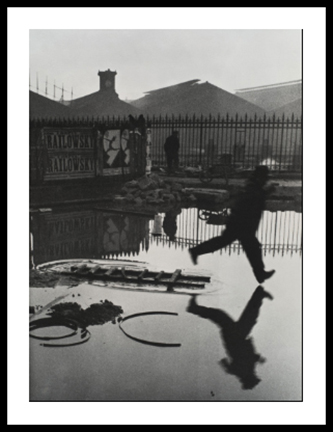
“Behind the Gare Saint-Lazare, Paris, 1932”
- A man leaps across a puddle behind the train station, his body frozen mid-air in a perfect arc, just before he splashes down.
- In the reflection, you see both the figure and the fence mirrored in water, creating symmetry.
- The timing is razor-sharp—literally a fraction of a second later, the magic is gone.
- Compositionally, everything aligns: the leaping figure echoes the ballerina on the poster in the background; the fence and puddle form geometric lines that organize the chaos.
- It’s not just form—it’s feeling. The joy and tension of that instant communicates something universal about life in motion.
Why it matches the quote
- “Hold one’s breath” → The suspended leap, a pause in time.
- “All faculties converge” → Perfect anticipation: eye, reflex, and intuition aligned.
- “Fact and organization of forms” → Both the literal event (a man jumping a puddle) and the abstract play of shapes and reflections coexist.
- “Head, eye, heart” → Technical mastery (head), instinctive framing (eye), and human empathy/joy (heart).

 viewfromthehandlebars.com