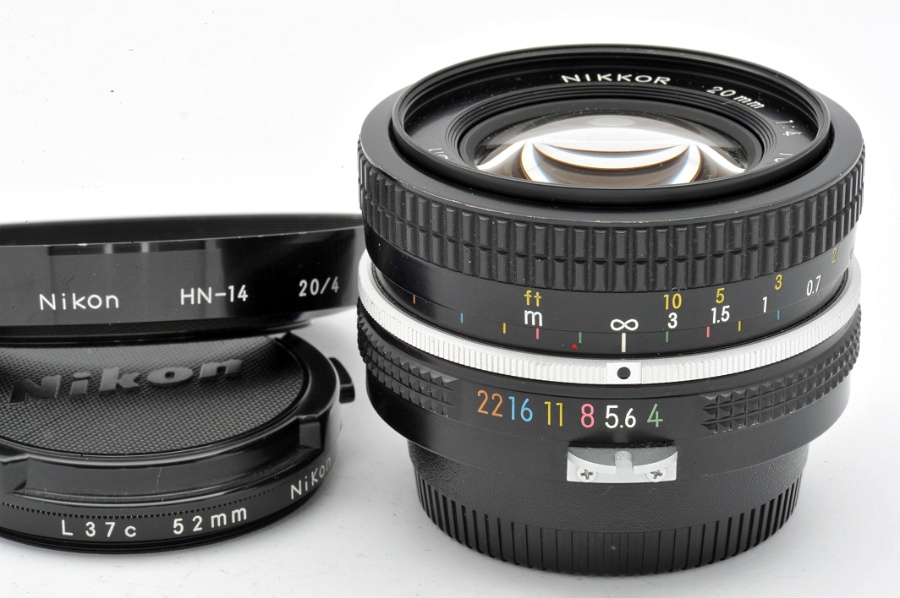
Lenses are a lot like paintbrushes—each with its own unique properties and purpose. We typically begin categorizing them by focal length, then by aperture range, often asking, Is it a fast lens? From there, we evaluate sharpness, whether the lens is a prime or zoom, and consider its weight, size, and cost. These characteristics not only shape how we shoot but how we see the world through the viewfinder. Over the past year, I’ve developed a deep appreciation for vintage lenses and have often thought of Shakespeare’s phrase, “What’s past is prologue.” My journey began when Nikon offered an irresistible employee purchase on the Nikon Z f—a mirrorless camera inspired by the classic FM2 of the 1970s and ’80s. Its tactile dials, textured finish, and retro Nikon logo reignited my curiosity about the mechanical era of Nikkor lenses and the optical artistry that defined it.
Nikon’s legacy of precision optics dates back to the early 1960s, when it introduced its first automatic diaphragm lenses marked “Nikkor Auto.” The term Auto referred not to autofocus, but to the automatic aperture mechanism that stopped down the lens only at the moment of exposure. Among these, the Auto-S series (for “seven elements”) appeared around 1964–1976, with iconic examples such as the Nikkor-S Auto 50 mm f/1.4. Built with Nikon’s original Non-AI mount and the signature “rabbit-ear” coupling prong, these lenses required manual indexing but delivered extraordinary craftsmanship and optical quality. Shortly before buying my Z f, I rediscovered this era firsthand when I purchased a used Micro-NIKKOR-P·C Auto 55 mm f/3.5—a legendary macro lens from the mid-1970s that remains impressively sharp and beautifully smooth to focus.
By 1977, Nikon modernized its system with the AI (Aperture Indexing) mount, which allowed cameras such as the F2A, FM, and FE to automatically read the aperture through a milled ridge on the aperture ring—eliminating the need for manual coupling. The AI-S line followed in 1981, refining the mechanism with linear aperture control, enabling cameras like the Nikon FA and F-301 to use Program and Shutter-priority modes. AI-S lenses are easily recognized by their orange minimum-aperture marking, smoother mechanics, and a small notch near the mount. While their optical formulas often mirrored earlier AI or Auto designs, the improved coatings, precision machining, and exposure automation represented the pinnacle of Nikon’s manual-focus engineering.
Today, these lenses—spanning from Auto-S to AI-S (1964 – 1987)—continue to captivate photographers for their tactile feel, solid brass construction, and the distinct rendering they produce on modern digital bodies. Pairing them with a camera like the Nikon Z f bridges two eras: the craftsmanship of analog photography and the flexibility of digital imaging. Whether exploring wide-angle perspectives with a 16–35 mm or the subtle micro-contrast of a vintage 55 mm macro, shooting with these legacy lenses is both a technical and creative rediscovery. Their imperfections are part of their charm—reminding us that photographic character often lies not in perfection, but in personality.

Nikon 28mm f/2
NIKKOR F, AI and AI-s (1970-2005)


Nikon 105mm f/2.5
NIKKOR F, AI and AI-s
| Feature | Auto-S (Pre-AI) | AI | AI-S |
|---|---|---|---|
| Years | 1964 – 1976 | 1977 – 1981 | 1981 – 1987 |
| Aperture Comm. | “Rabbit-ear” prong only | Mechanical ridge (auto indexing) | Linear lever + notch for program / shutter control |
| Focus | Manual | Manual | Manual |
| Compatibility | Early Nikon F / F2 (manual indexing) | All AI-compatible bodies | AI + Program / Shutter-priority bodies |
| Innovation | Automatic diaphragm | Auto aperture detection | Linear aperture for automation |
| Example | Nikkor-S Auto 50 mm f/1.4 | Nikkor 85 mm f/2 AI | Nikkor 85 mm f/2 AI-S |

 viewfromthehandlebars.com