Daily – thoughts
2026.03.14 Saturday – Thoughts
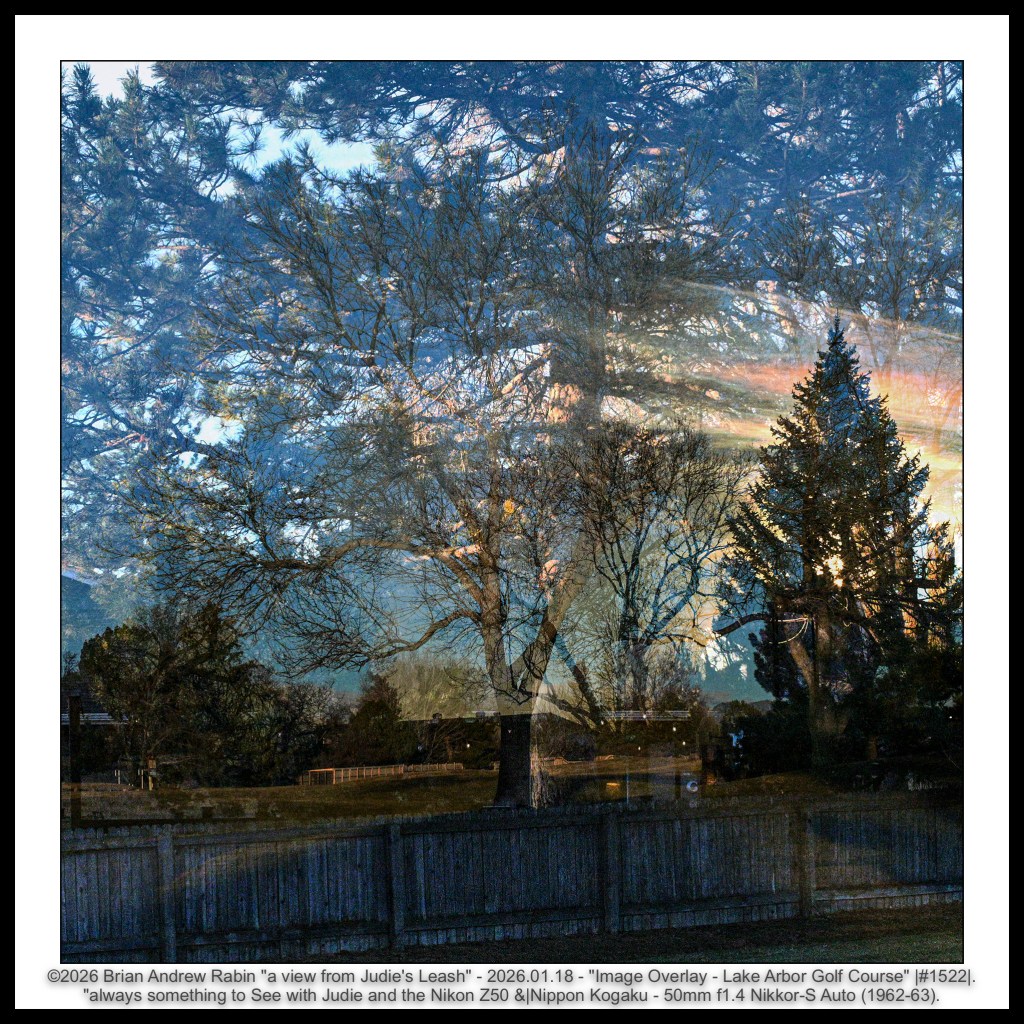
©2026.01.18 Brian Andrew Rabin “reflections of an aging neighborhood as the morning light changes” from — A View from Judie’s Leash — Image Overlay
This morning Judie and I were out before sunrise. The neighborhood was quiet — sound asleep, I thought, while the world moves fast. Walking in that early dark I found myself thinking about layers. About how aging and changing are really the same word, just used differently.
The image above is three moments of the same street laid over each other in a single frame — the way memory works, the way time works. I have been experimenting with that lately. Overlapping exposures. The present and the recent past occupying the same space simultaneously. I think that is also where I am living now, in both mind and reality.
For fifty-eight years I experienced change the way most people do — a little at a time. My own aging, a little at a time. My parents aging, a little at a time. Friends drifting, the country shifting, the world turning — all of it gradual enough to absorb, adjust to, and process. But now everything feels accelerated. More all at once than a little at a time.
My parents, who moved to Colorado in recent years to be close to me, are aging in ways I can no longer look past. Friends of twenty, thirty, forty years are moving away — other states, other countries, other lives, chasing dreams and economic realities I understand but still feel as a quiet loss. I am approaching fifty-nine. The arithmetic of that is not lost on me.
Walking with Judie this morning, I was listening to the previous night’s Real Time with Bill Maher — Governor Shapiro as the guest, talking about antisemitism and what it means to be a Jewish politician in America right now.
Earlier this week I had been listening to Peter Zeihan on The Prof G Pod with Scott Galloway — a conversation that started with the Iran war and oil markets and kept pulling me toward Zeihan’s longer view of where America is actually headed and what is quietly giving way beneath us.
Two very different conversations. The same undercurrent running through both. Something shifting. Something that used to hold, no longer holding.
Today my mother asked me about her driving. I had to tell her she can’t — not until the neurologist clears her. This is what all at once looks like up close. Not geopolitics. Not oil markets. Just my mother’s face when I said it. All of it layered in the same frame. All of it at once.
As i type I am thinking of two artists – Hemingway, and of the lesser-known photographer Stephen DiRado.
For twenty years he turned his camera toward his father, Gene, as Alzheimer’s slowly took hold — photographing what must have been tremendously difficult: a parent in their most diminished states. Through quiet, transformative black-and-white images, he bore witness to that long unfolding.
DiRado later wrote: “I slowly became aware I was working on a photography project. Once I identified the disease my father was succumbing to, I knew it was not going to end well.” Stephen DiRado
I am often reminded of Hemingway, not just today. – In The Sun Also Rises (1926), one character asks another how he went bankrupt.
“Two ways. Gradually, then suddenly.”
Brian – 2026.03.14
Pentagon Press Briefing – The Dimmest Bulb Amongst a World of Shining Stars
Secretary Pete Hegseth & Gen. Dan Caine
March 13, 2026
Pentagon Briefing Room
Listening to the press conference this morning with the self-styled “Secretary of War,” Peter Hegseth — wow.
Pardon me for saying it, but the word that comes to mind is Orwellian.
As I stood outside watching Judie sniff through the wet grass — occasionally pausing to inspect some mysterious bug with great seriousness — Hegseth spoke on the screen about the war, about the media, about “fake news,” denouncing reporters and praising a future where technology executives might reshape the information landscape.
At one point he remarked that he looked forward to a time when Larry Ellison might take over the media ecosystem — a comment that, in the moment, landed with a strange mixture of bravado and unease.
The language felt familiar in a way that was hard to ignore:
the dismissal of journalism, the insistence on a singular narrative, the suggestion that the truth itself might soon have a new corporate custodian.
Standing there with Judie tugging gently at the leash, the thought drifted through my mind:
How Orwellian.
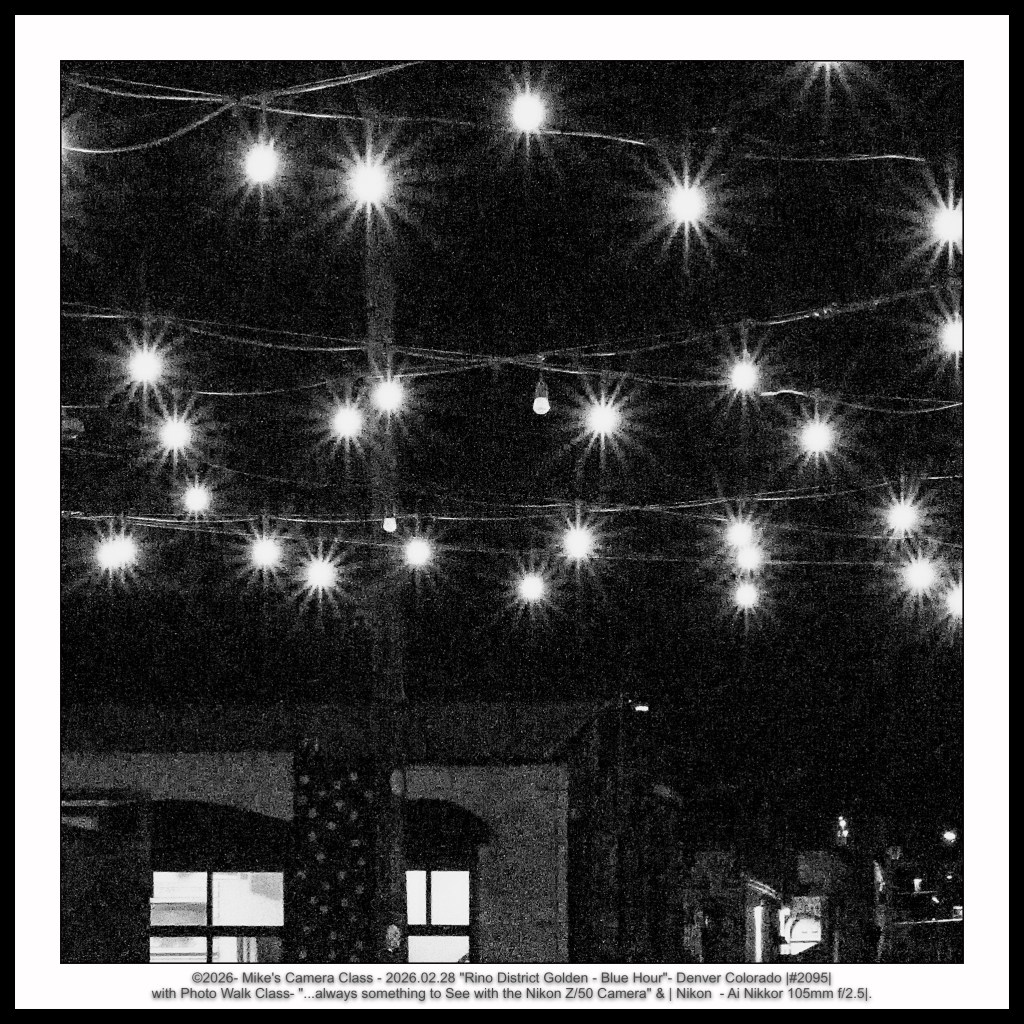
Looking at this photograph from our RiNo photo walk, what strikes me now is the way the lights scatter across the frame. Each bulb radiates outward, bursting into sharp points of light against the darkness. Together they form a field of brilliance — many sources illuminating the night.
And yet, in the middle of all that brightness, one bulb hangs dimmer than the rest.
Strangely, like the photograph itself, it is often the dimmest bulb that becomes the hardest to look away from.
Listening this morning to the press conference from the Pentagon, the image came back to mind. The rhetoric was loud, confident, and certain — denouncing the press, declaring clarity where uncertainty still lives, and promising control over the narrative of events still unfolding.
Standing outside earlier with Judie, watching her nose move slowly through the grass while the world around us woke, to the morning, I found myself thinking about light.
At its best, leadership illuminates—allowing truth to shine and helping people see more clearly.
But sometimes the brightest, Loudest voices are not the brightest lights.
And at times, in a world of many voices—citizens, reporters, analysts, diplomats, soldiers—the truest illumination comes not from a single bulb, but from many points of light shining together.
Like the starbursts in this photograph.
Brian – 2026.03.13
Pre-Sunrise Walk with Judie
These were the thoughts drifting through my mind on this morning’s walk with Judie, my twenty-pound pug.
March 12, 2026
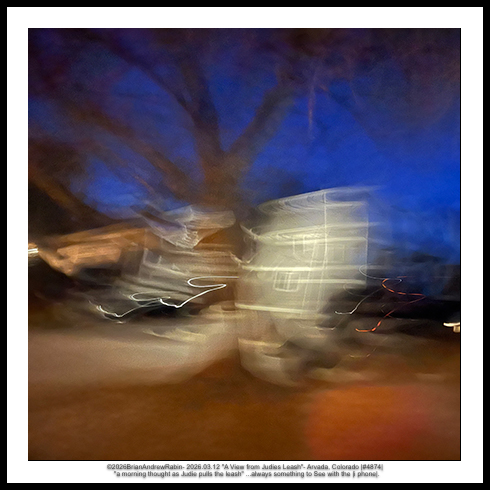
Not every day begins as a pretty picture, or even with an Egglestonian view of the world around me. Some mornings arrive in fragments—blurred shapes, stray light, and half-formed thoughts. The neighborhood was still mostly asleep, the sky deep blue before sunrise, when Judie suddenly bolted after a rabbit.
Moments later she was barking furiously at a large German Shepherd on the other side of a white panel van. The shepherd growled while a petite woman in her thirties braced the leash with all the strength her ninety-pound frame could muster. It was a small drama playing out in the quiet of the morning.
Yesterday had carried its own weight. The day began with my mother being taken by ambulance to Lutheran Hospital after a severe headache raised fears of another stroke, following last week’s minor one affecting the left side of her brain. The ambulance left around nine in the morning. By evening, life folded back into its routines—mom was home from the hospital and I still had an online class to teach at 6:30 p.m.
Before class I stopped in the kitchen for a glass of iced tea and noticed my mother removing a stainless-steel coffee mug filled with chicken soup from the microwave.
“Mom,” I said gently, “stainless steel doesn’t go in the microwave.”
“Oh yeah—I forgot,” she replied.
There have been more moments like that lately. I suggested she heat the soup in a traditional pot instead. She nodded, and I carried my iced tea upstairs to begin teaching that evening’s class—an online critique discussing the work of Susan Meiselas, starting with 44 Irving St. and including her seminal work Carnival Strippers.
Walking this morning with Judie, the neighborhood lights streaked and shifted as the camera moved in my hand. The image feels the way the morning felt—part memory, part motion, part uncertainty.
Some mornings begin clearly.
Others begin like this.
Next on the agenda is a visit to my mother’s general practitioner for a post-stroke checkup.
Brian -2026.03.12

 viewfromthehandlebars.com