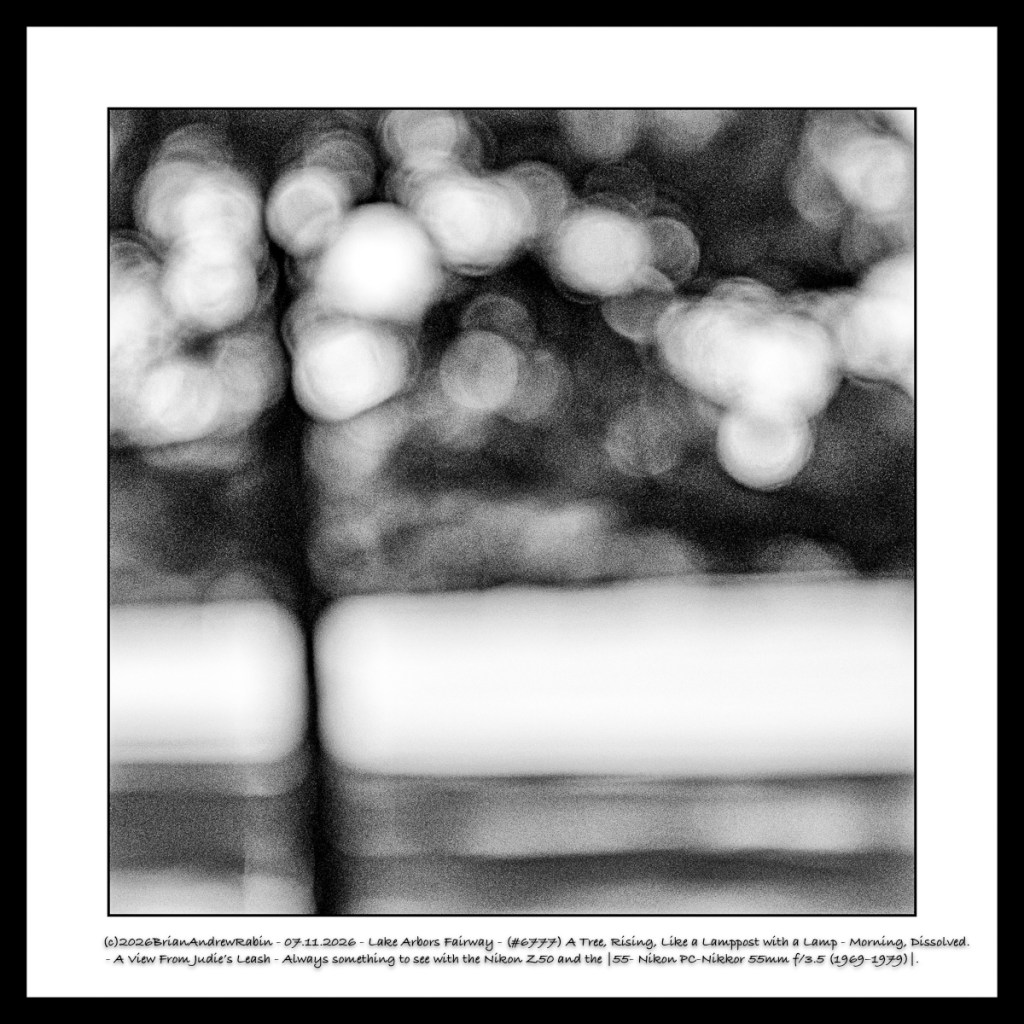
There’s a moment on the walk with Judie where the world stops resolving into things and just becomes light — a tree trunk, a fence, a scatter of bokeh standing in for branches. Shot wide open on the Nikon PC-Nikkor 55mm f/3.5 (1969–1979), a lens older than most, with its own point of view.
Some mornings the light of the day does half the composing for you. The lens does the rest — not because it fails to focus, but because it was built for a different kind of seeing, one that predates autofocus certainty by half a century. Point it wide open at a fairway at dawn and it stops asking what things are and starts asking what they feel like: a lamppost becomes a suggestion, a fence rail becomes a horizon line, and the tree — rising through both — holds the frame together the way a held breath holds a sentence together.
Judie doesn’t care about any of this. She’s already three steps ahead, nose down, working some scent I’ll never know the name of. But it’s her pace that makes the picture possible — unhurried, looping, willing to stop wherever the leash goes slack.
A week on, the image reads differently, to me. It’s stopped being Lake Arbors, stopped being July. What I see now is a cold night, somewhere — any city, really — standing at the edge of a skating rink that hasn’t opened yet, breath fogging, the ice lit up and empty under whatever lamps a place like that uses at that hour. It could be here. It could be anywhere. That’s the thing about a picture once it’s had time to sit: it stops belonging to the place it was taken and starts belonging to whatever it happens to resemble in memory.
A Photograph like this isn’t taken so much as it is arrived at.

